Why AI Can’t Solve the Timing Problem
The entire discipline of time series forecasting exists to answer one question: “WHAT will the next number be?” The spectrum of forecast models from simple moving averages to complex machine learning and multi-variable neural network configurations represents variations on HOW to answer that question. The problem isn’t merely that this is the wrong question: you don’t need to know WHAT the next number will be; you need to know WHEN to act. The problem is that this question is impossible to answer with any degree of certainty — no matter how much AI you throw at it.
Seasonal Models and a Microscope for Time
Think of the Model of Temporal Inertia as a Microscope for Time. When you view a drop of water through the lens of a microscope, you can see a world of single-cell organisms that are otherwise invisible. When you view time series data through the lens of the complex, irregular seasonal models that I’ve developed, you can see patterns and cycles that are otherwise invisible. Those patterns allow us to see further into the future with greater detail, precision, and confidence than possible with any existing tool. Each seasonal model is a lens in the Microscope for Time, revealing patterns of unbalanced force along the seasonal timeline.
The Model of Temporal Inertia
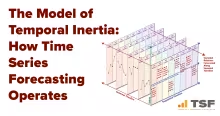
Newton’s First Law of Motion, the Law of Inertia, states that an object at rest remains at rest, and an object in motion remains in motion in constant speed and in a straight line unless acted on by an unbalanced force. The Model of Temporal Inertia proposes that the values of data organized in a time series will follow the same trend (speed and direction) until acted on by an unbalanced force. The Model of Temporal Inertia addresses each of the foundational problems that limit the confidence in classical time series forecasts. The Model of Temporal Inertia does not require stationary data and is able to generate forecasts with untransformed, raw data. Rather than isolating and discarding the random elements of data, the Model of Temporal Inertia captures those elements as seasonal relatives and forecasts when the effects of the unbalanced forces are expected to change.
TSF Videos
Start Here TSF

Don’t Buy the Racehorse — Bet the Horse Race | The Industrial Revolution of Forecasting

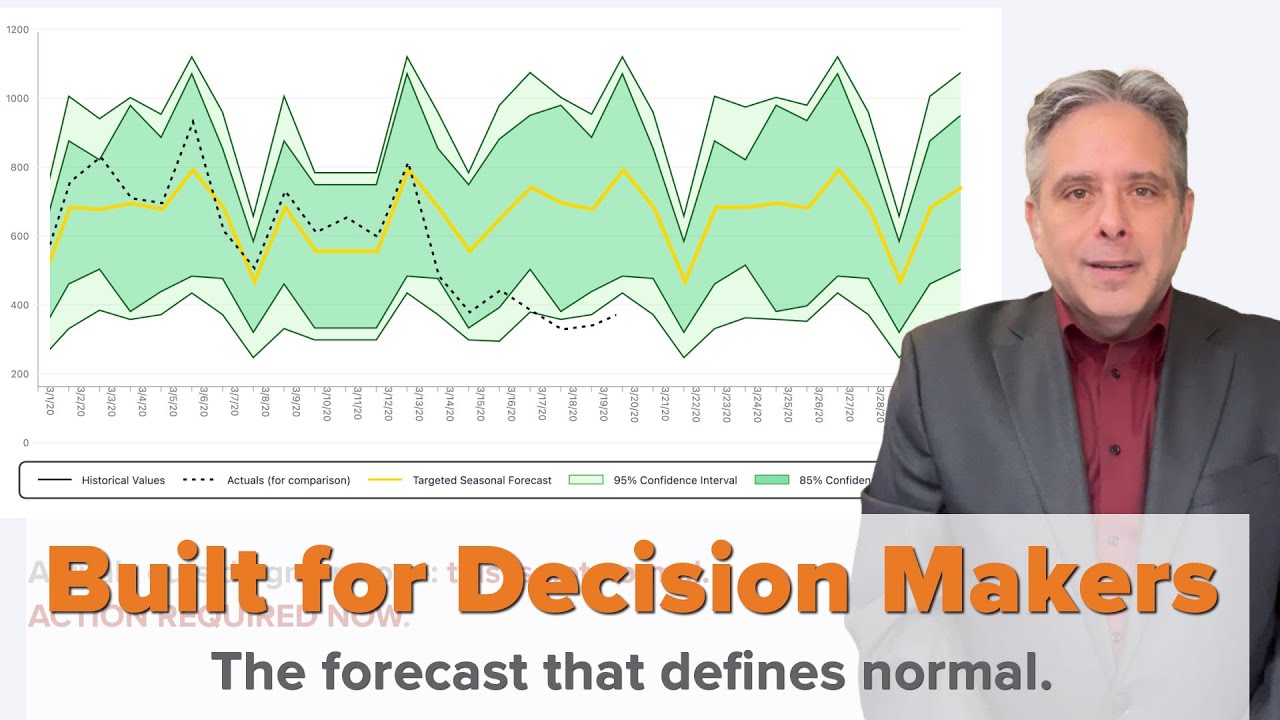
One Chart to Rule Them All | The Future of Demand Planning with TSF
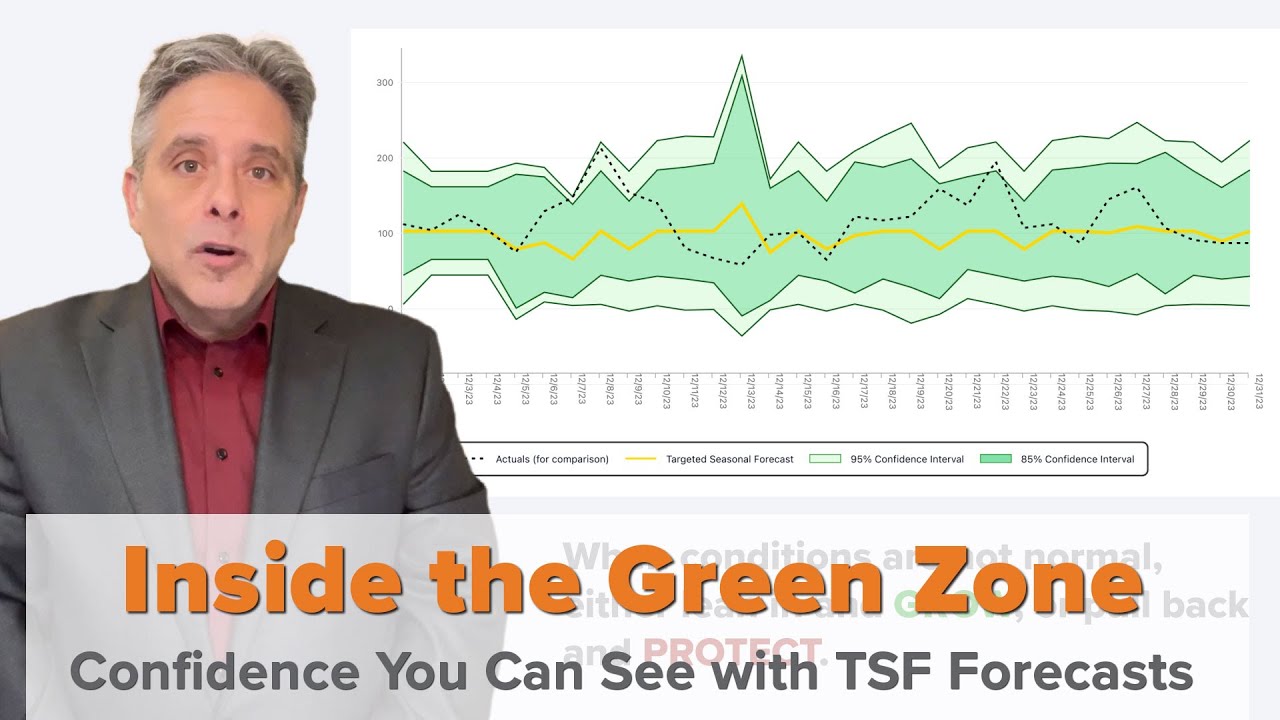
Inside the Green Zone | Confidence You Can See with TSF Forecasts

Defining Normal: Know When Opportunity Knocks | TSF Decision Framework